Engineering teams often reach a key decision early in product development: should a component be formed from sheet material or machined from solid stock? That choice affects cost, lead time, structural integrity, and manufacturability.
Understanding the differences between metal fabrication and machining helps engineers align part design with the most efficient production method. When comparing fabrication and machining, manufacturers typically evaluate geometry, tolerance requirements, and production scale before committing to a process.
Material Forming Methods
One of the clearest distinctions between fabrication and machining is how the material is shaped. Fabrication forms flat metal into functional parts through cutting, bending, and joining processes.
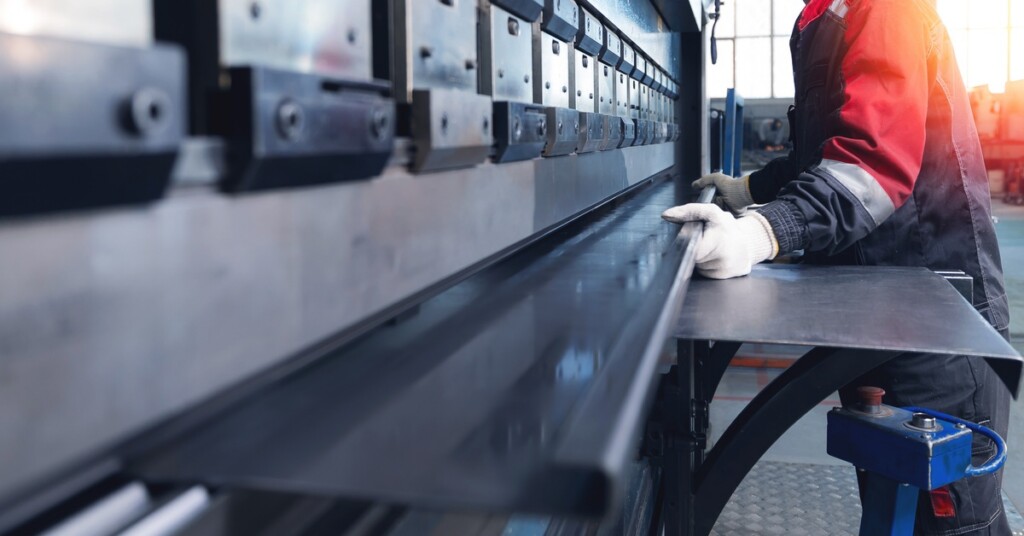
In sheet metal fabrication, flat stock is shaped using operations such as laser cutting, press braking, and welding. These forming techniques produce structural components like brackets, enclosures, and panels while preserving the material’s inherent strength.
Machining takes a different path. Computer Numerical Control (CNC) equipment removes material from a solid block through milling, drilling, and cutting until the final geometry is reached. This method allows tight dimensional control and consistent repeatability.
Part Geometry Requirements
Part geometry often determines which process is the better fit.
Fabrication works best when parts originate from flat patterns that require bends, flanges, ribs, or welded assemblies. These components commonly appear in enclosures, frames, panels, and structural housings used across industrial equipment and electronic systems.
Machining becomes the preferred choice when designs require intricate shapes or internal features that cannot be formed from sheet material.
Common examples include:
- Multi-surface precision features
- Internal pockets or channels
- Threaded holes and precision bores
- Tight mating surfaces for assemblies
Starting from solid stock allows machining to produce complex three-dimensional geometries that forming methods cannot easily achieve.
Production Efficiency Considerations
Production efficiency is another major factor when comparing fabrication and machining.
Fabrication workflows often support faster production for parts that can be cut and formed from flat sheets. Once the flat pattern is programmed, the manufacturing sequence can move quickly through cutting, bending, and assembly.
Machining typically involves longer cycle times because material must be removed gradually. However, it provides exceptional precision and repeatability for parts requiring tight tolerance control.
Integration With Assembly Processes
Another difference between metal fabrication and machining lies in how components move through final production.
Fabricated parts often serve as structural elements within larger assemblies. Panels, brackets, and enclosures produced through forming processes typically move directly into welding, finishing, and mechanical assembly operations.
Machined components frequently serve as precision interfaces within those assemblies. They provide mounting surfaces, alignment features, and connection points that require extremely accurate tolerances.
Evaluate the Best Path Forward
Choosing between fabrication and machining ultimately depends on how the component must perform in the final product. Some assemblies benefit from formed sheet structures, while others rely on machined precision features.
At Sytech, our ISO-certified facility integrates precision sheet metal fabrication, CNC machining, welding, finishing, and assembly under one roof. Our engineering team works with customers early in the process to review manufacturability and identify the most efficient production path. Contact us today to discuss your project and see how our end-to-end manufacturing capabilities can support your next build.